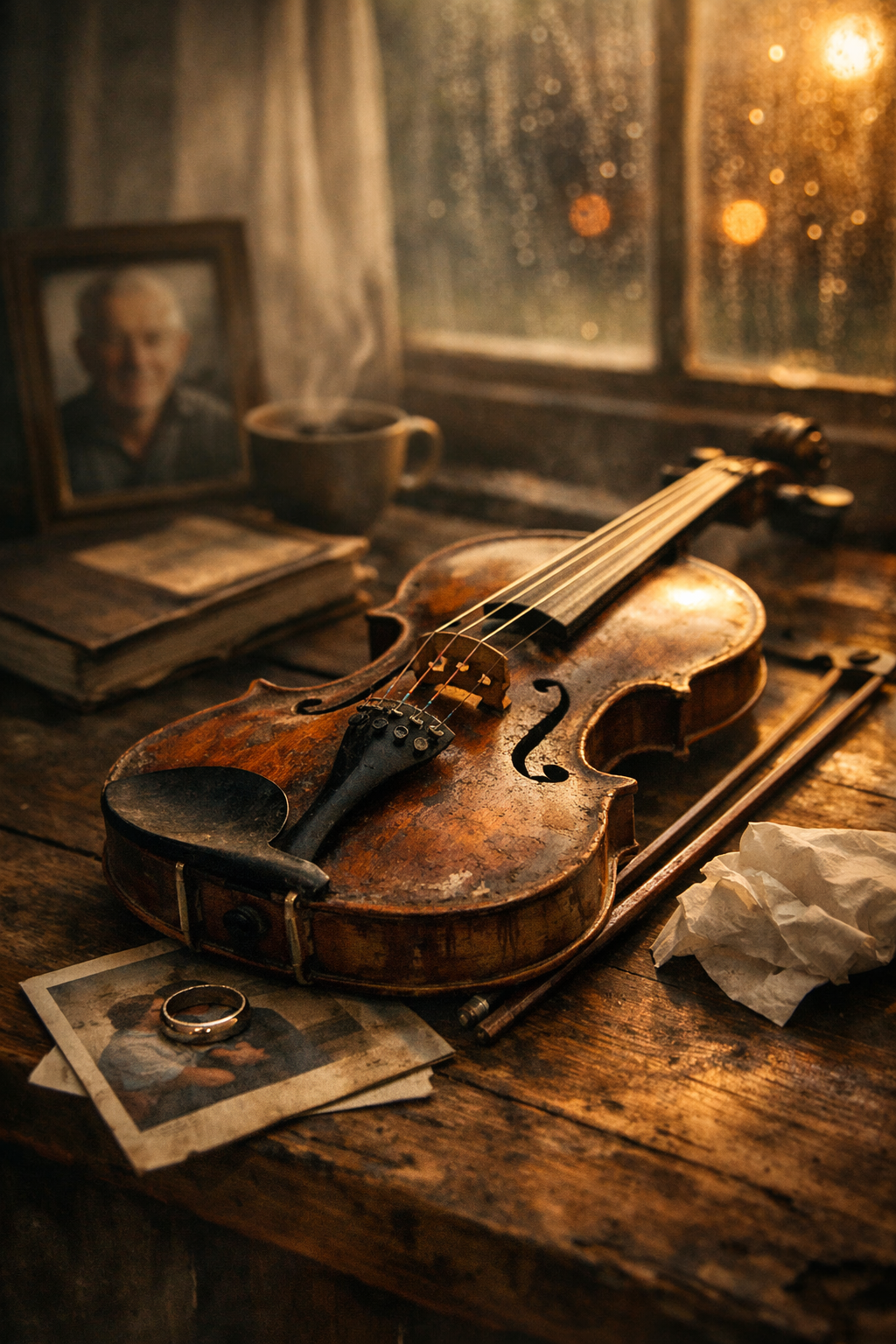
There are moments in a man’s life when the absence of his father becomes louder than it ever was before.
Not in the dramatic ways people expect, not as a sharp ache or a sudden collapse, but as a quiet, disorienting gap. A missing place to rest your weight. A voice you instinctively reach for and realize, again, isn’t there.
For me, that absence has grown especially pronounced lately, marked by limbo, heartbreak, and the steady responsibility of holding a family together while parts of my own identity feel loosened and unsure. These are the moments when I find myself wanting a father not to fix anything, not to offer strategy or advice, but simply to witness. To say, I see you. You’re still you. Stay steady.
My dad has been gone for several years now. Most days, that fact sits quietly in the background of my life. But around the holidays, or when I notice the loneliness in my mom’s voice, it comes forward again. Grief doesn’t always announce itself – sometimes it just waits for moments like these, when the scaffolding you’ve relied on starts to feel less certain.
What I miss most isn’t instruction. It’s regulation.
And to be honest, my father wasn’t always steady when I was growing up. He carried his own armour, his own stresses, and there were years when warmth came second to endurance. I see echoes of that in myself now — the reflex to tighten, to manage, to hold emotion at arm’s length. But I also saw who he became later, when the weight eased and the noise quieted. Softer. More present. Admirable in a way that felt earned rather than assumed. That version of him matters too.
The way a good father steadies the room just by being in it. The way his presence slows your breathing, sharpens your sense of proportion, reminds you that panic doesn’t get to drive. That even when things are hard, you don’t have to abandon yourself to them.
For a long time, my father-in-law filled some of that space in my life. He became a steady presence, a man I respected deeply, maybe even a second chance at having a father nearby. But by the time he entered my world, I had already learned to wear armour. I didn’t know how to fully open myself to needing him. And now, in this strange limbo, the remaining “dad” in my life is someone I can’t lean on… not because he isn’t kind, but because circumstances have quietly closed that door.
That absence feels different. Less final. More suspended. And in some ways, harder to name.
Without that external anchor, I’ve been learning — awkwardly, imperfectly — to internalize it.
To pause instead of react.
To choose restraint over desperation.
To let discomfort exist without rushing to escape it.
There are days when everything in me wants reassurance, certainty, proof that things will turn out the way I hope. But I’ve come to see how quickly that wanting can slide into grasping and how grasping erodes dignity. My father understood that instinctively. He didn’t need to say it. He lived it.
Now, when I feel myself fraying, I try to ask a quieter question: What would steadiness look like here? Not strength as performance. Not stoicism as suppression. Just calm, grounded presence, especially for my children.
Because even when I’m unraveling inside, they don’t need to carry that weight. They need a father who shows up evenly. Who listens without spilling. Who models that hard feelings don’t require hard reactions.
I’m beginning to understand that becoming the father I wish I still had isn’t something that happens in sweeping moments or noble declarations. It happens in small, almost invisible decisions. In the choice to sit with uncertainty. To speak gently when it would be easier to lash out. To stay when withdrawing would feel safer.
It happens when I regulate myself because no one else can do it for me anymore.
There’s grief in that realization but there’s also inheritance.
Not the kind passed down through stories or advice, but the kind transmitted through example and absorbed over time. My father showed me how a man holds himself when life presses in (and, to be honest, not always in the best form). Now, in his absence, that lesson is finally being tested.
And maybe this is how it’s meant to be.
Maybe the truest thing a father leaves behind isn’t certainty or protection, but a pattern — one that emerges quietly, years later, when his son realizes he’s beginning to move through the world the same way. Steadier. Quieter. More grounded than he once thought possible.
Not because the pain is gone.
But because he’s learned how to hold it.
And I don’t always get everything right. And that’s okay.