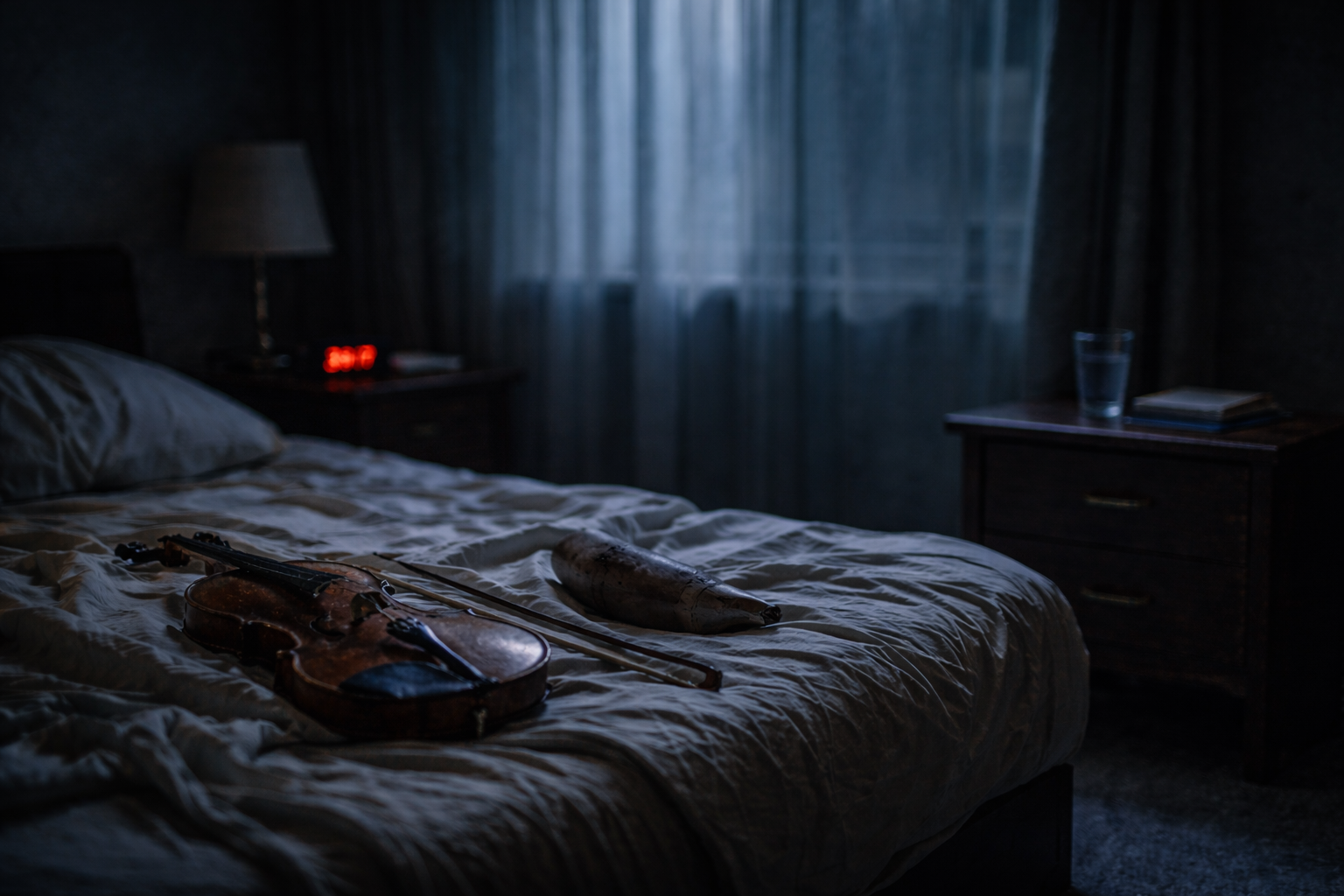
Months into restraint – this winter in particular – my sleep has been poor.
I fall asleep, but I do not stay asleep. I wake often. Sometimes abruptly. Sometimes soaked in sweat. My heart already ahead of my thoughts. The dreams are vivid and relational. They involve her, or people who are her but not her. Relationships that are broken, nearly broken, or suspended in that quiet, corrosive state between.
Some nights the fear sharpens.
She has moved on. She is married. I see signs of it… sometimes literally. A car pulling away with cans trailing behind it. Just married. The message is never subtle. The implication is final.
And in the dream, I do nothing.
I watch. I register it. I feel the loss fully, yet I still practice restraint.
Waking is not relief. It is re-entry.
The moment consciousness returns, I remember where I am, in this prolonged, undefined limbo. The body is exhausted. The nervous system is alert. Getting back to sleep becomes difficult because I am now awake with the knowledge. The night does not soothe; it confronts.
This carries emotional pain. Real pain. Physical too. Naming that does not weaken discipline, it clarifies the cost.
What restraint governs and what it doesn’t
Stoicism draws a clear boundary between what is ours to govern and what is not. Judgment, action, assent – these remain within reach. The body does not.
Sleep is not a moral domain. Dreams are not choices.
In waking life, restraint is a deliberate act. An impression arises – longing, grief, fear – and I do not grant it permission to become action. By day, this often appears unremarkable: calm conversation, measured responses, no reaching, no pressure, no visible signs of collapse.
Sleep removes the gatekeeper. The mind continues working, even when the will is offline.
REM rebound, briefly and plainly
When REM sleep has been fragmented or suppressed – by stress, vigilance, emotional load, or prolonged restraint – the brain compensates by intensifying it when it can.
This does not create rest. It creates density. This is REM rebound.
Dreams become longer, more vivid, more emotionally charged. The mind uses REM sleep to process what waking life has deferred or contained.
This is not pathology. It is function.
Hyperarousal and fear without narrative
Alongside this is hyperarousal, a state where the nervous system does not fully stand down. The body remains alert even at rest. Sleep becomes shallow. Easily fractured. The boundary between dreaming and waking thins.
Fear enters here, not as panic, but as rehearsal.
The future arrives early, fully formed, without context or mercy. Loss is presented as a settled fact. The mind does not argue with it. It observes it.
That is why the waking comes fast. Why the sweat is already there. Why returning to sleep feels like asking a guard to abandon his post.
Why the dreams rehearse restraint
What matters most is not that fear appears. It’s that restraint remains.
In the dreams, I do not intervene. I do not plead. I do not collapse. I witness outcomes I do not want and cannot control, and I remain still.
This is not avoidance. It is the psyche practicing the only posture it knows how to hold right now – containment without illusion.
The dreams are not telling me what will happen. They are showing me what I fear could happen. And they are testing whether fear alone is enough to move me.
So far, it isn’t.
One night, more clearly than most
One dream from this past week has stayed with me.
In it, I was in a massive house. A mansion, really. Too many rooms. Too much space. More than I needed. She was there briefly, then left without explanation. I understood, without being told, that the relationship was finished. I didn’t chase her. I let her go. The pain was present, but contained.
Instead of using one of the immaculate bathrooms in the house, I found myself in a small, neglected one. Poor lighting. Rusted fixtures. Lukewarm water. I showered there.
When I came out, there was banging at the back door. The entire rear of the house was glass. I could see them clearly… my extended family. Aunts. Uncles. Cousins. Brothers. Not my children. Not her.
I swallowed the pain, opened the door, and greeted them with practiced enthusiasm. I gave a tour of the house… one I wasn’t even sure I owned, or was simply occupying for a while.
A Stoic frame for fear and pain
Stoicism never promised comfort. It promised alignment.
Fear is an impression. Pain is a sensation. Neither is a command.
As Marcus Aurelius wrote:
“If you are distressed by anything external, the pain is not due to the thing itself, but to your estimate of it; and this you have the power to revoke at any moment.”
That does not mean the fear disappears. It means fear does not decide.
I do not judge these dreams.
I do not indulge them.
I do not argue with them.I note them.
What remains mine to govern
By day, I practice restraint openly – measured, visible, and intact. I’ve written elsewhere about that work, about choosing dignity over demand and silence over reach.
By night, the body processes the cost.
I wake. I sweat. I remember futures I do not want and outcomes I cannot prevent. Sometimes I lie awake longer than I’d like, aware of how little certainty I’ve been granted.
This does not invalidate the work. It confirms it.
Restraint governs conduct, not consequence. Virtue does not anesthetize the nervous system. Choosing rightly does not spare the body from adaptation.
The violin string under tension vibrates more easily. That is not failure of craftsmanship. It is physics.
Sleep has simply become the place where the music plays without my hands on the instrument.
So I wake.
I observe.
I continue.Not because I am unafraid but because fear does not outrank alignment.