
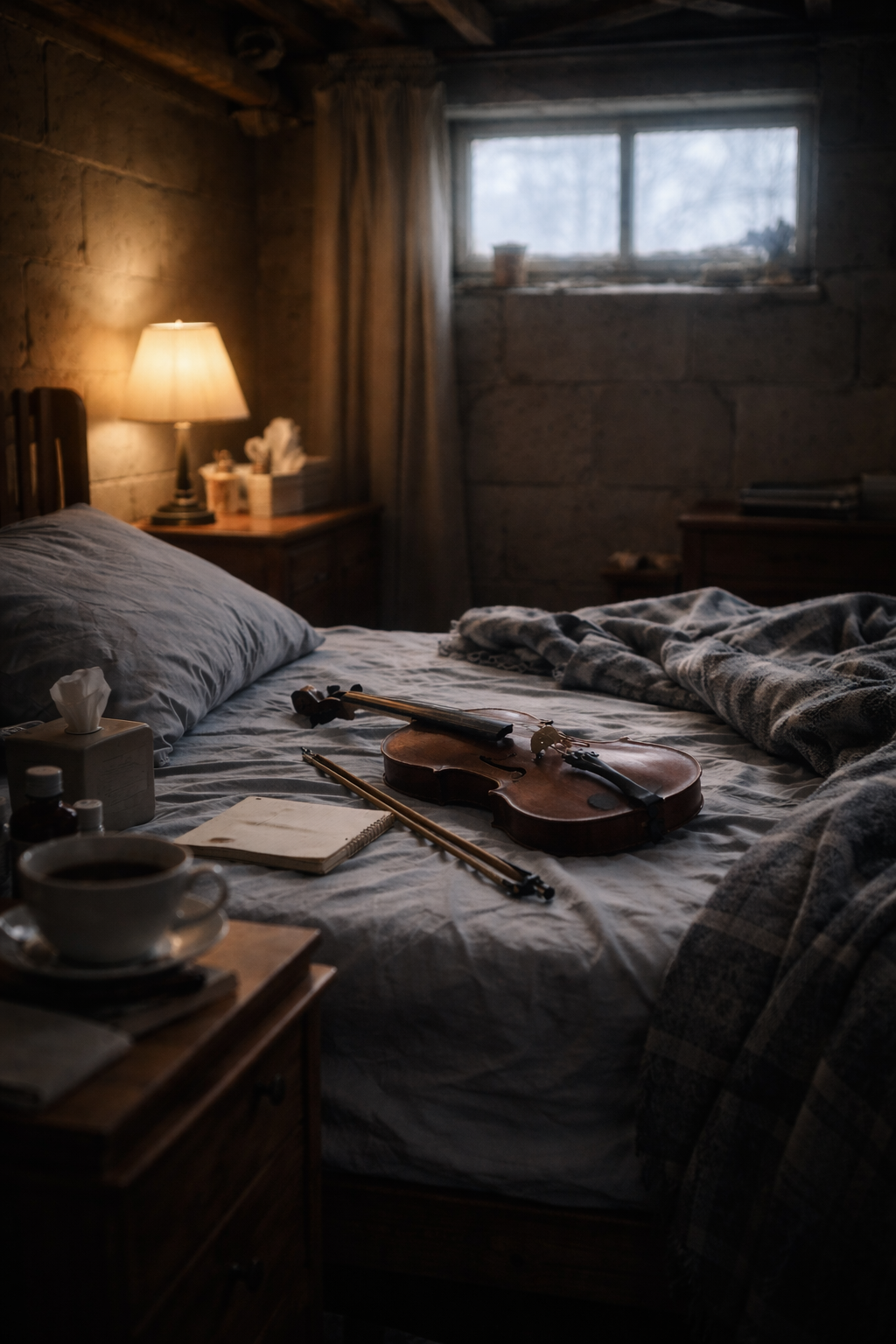
I’ve had the flu since New Year’s Day.
The kind that pulls you inward.
Fever. Body aches. Sleep that comes in waves but never quite restores.
Days measured not by clocks but by when you last woke up confused, thirsty, and aching.
On its own, it would be manageable. But my body didn’t get sick in a vacuum. It got sick while I was already carrying something heavier.
Trauma doesn’t pause when the body fails. If anything, illness strips away the last defenses you didn’t realize you were still holding.
When you’re healthy, you can distract yourself. Move. Work. Exercise. Stay busy. Convince yourself you’re coping because you’re functioning.
When the body gets sick, there’s nowhere to go. You’re forced into stillness. Into the house. Into the room. Into yourself.
And that’s when the mind starts to wander. Not loudly at first. Quietly. Between naps. In the half-awake moments when your body is too tired to fight and your mind is too alert to rest.
Physical isolation turns up the volume on emotional loneliness. This wasn’t the intentional kind of solitude I’ve written about before—about keeping the circle small—this was isolation imposed by a body that had no choice but to stop.
You can be surrounded by people and still feel profoundly alone. Like you’re living in the house but not of it. Present, but slightly out of phase with the life happening around you.
At times, it felt like I was an outsider in my own home.
Illness adds a strange distortion to trauma. Some things get louder. Old memories surface without invitation. Questions you’ve been holding at bay drift back in.
What does this mean?
Where do I belong right now?
Am I wanted, or just tolerated?
The fever doesn’t create these thoughts, it weakens the walls that usually keep them at a distance.
Other things go numb.
The body doesn’t have energy for full emotional expression.
Grief flattens.
Anger dulls.
Even hope feels muted – not gone, just temporarily inaccessible.
It’s not peace.
It’s exhaustion.
There was guilt too. Not the loud kind. The quiet, familiar kind that knows exactly where to press.
Being sick reminded me of the old me – the version that would disappear. Not leave, exactly. Just fade out of the room, out of the family rhythm, into his own head.
Illness made it look similar from the outside.
Downstairs. Door closed. Hours passing.
And even though the reason was different, the shape of it felt the same. That resemblance hurt.
So I’d get up. Not because I felt strong but because I didn’t want to rehearse that old role again.
I’d struggle upstairs. Sit with them. Eat a little. Say very little.
I wasn’t there to be energetic or helpful or “on.” I was there to be visible. To remind them, without words, that I’m here too. That disappearing is no longer who I want to be, even when my body is weak.
Still, the nights were the hardest.
At one point, I was awake in that dim, disoriented space between sleep and fever.
The house was quiet. My door slowly opened. It was my ten-year-old daughter.
Just her head at first, peeking in. Checking. I waved her closer. She came in and smiled. So did I.
We talked for a bit. Nothing important. Nothing heavy. Just presence. Then she said, almost casually,
“I’ve been checking on you a lot.”
I smiled and asked how much.
“Like six times already.”
I had to hold back my tears.
In that moment, the loneliness didn’t disappear but it loosened. Not because everything was okay. But because love had found me anyway.
Trauma and illness together blur things. They tangle intention and impact. They ask old questions in new circumstances.
Am I withdrawing again?
Or am I resting?
Am I protecting myself?
Or am I leaving?
The body doesn’t answer those questions. It just asks for what it needs. So I kept choosing presence in the smallest ways available to me.
Not to prove anything. Not to erase the past. But to stay aligned with the man I’m becoming even while sick.
The violin metaphor feels especially close right now.
A violin can’t be forced to play when the wood is cold, when the strings are loose, when the instrument itself needs rest.
Pushing only creates harsh sound. False notes. Damage. So the instrument is set down. Not abandoned. Not broken. Just waiting.
This kind of sickness takes things away – momentum, distraction, the illusion of control.
But it also adds clarity.
It shows where you’re tender. Where you’re lonely. Where love still reaches you, quietly, when you least expect it.
If you’re reading this while sick – physically, emotionally, or both – hear this gently:
Being sick is not a failure of you.
It is not a failure of your progress.
It is not proof that you’ve undone the work you’ve done.
It’s natural.
And when you’re eroded through and through, this is not the moment to fix anything.
Effort won’t heal you here.
Gentleness will.
Rest is not avoidance.
Stillness is not abandonment.
Pausing does not erase who you’ve become.
The instrument is still yours.
And when it’s ready,
it will sound again.