
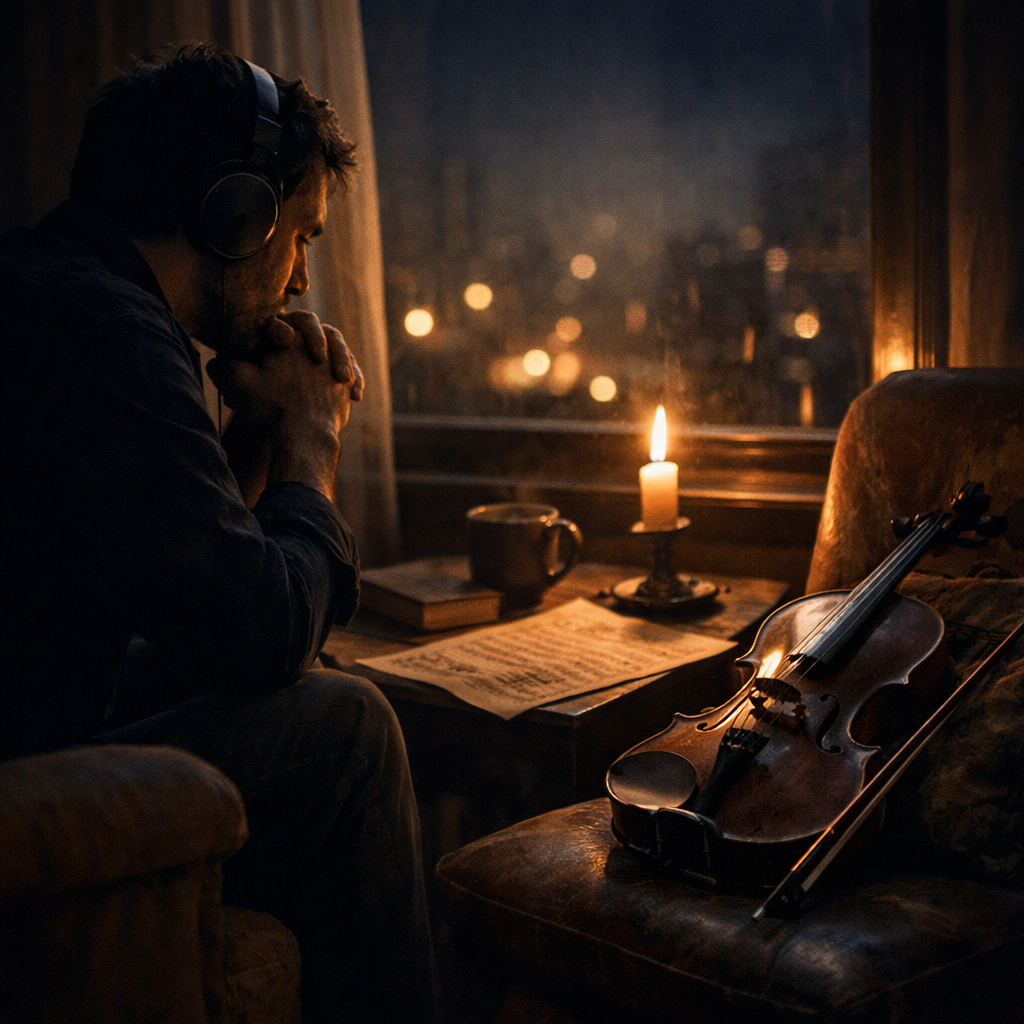
My daughter asked me the other day, “Why do you always listen to sad music?”
I have a playlist on Spotify called Becoming Me and, yes, it leans heavily towards the sombre. Violin. Classical. Songs that ache more than they resolve. As I type this post, it’s on in the background (it always is, in some way).
She’s ten. So I didn’t give her the whole answer.
I said something simple. Gentle. Age-appropriate. But it wasn’t the truth. Not all of it.
The real reason is this – sad music lets me feel.
For a long time, I didn’t. Or more honestly, I trained myself not to.
I believed strength meant distance.
That composure meant control.
That moving forward required leaving certain emotions behind.
So I did what many of us do.
I stayed busy. Productive. Functional.
I learned how to outpace sadness instead of sitting with it.
But sadness doesn’t disappear when ignored.
It waits.
What sad music actually does
When I listen to somber music (violin, classical, songs weighted with longing) it doesn’t pull me under.
It slows me down.
My body settles. My breath deepens. The noise quiets.
There is no demand to fix what I feel, only permission to notice it.
This matters more than it sounds.
The nervous system doesn’t learn safety through avoidance.
It learns safety by experiencing intensity without threat.
Sad music becomes a container – a place where grief, regret, fear, and uncertainty can rise without overwhelming me.
I’m not drowning in sadness.
I’m digesting it.
This is not indulgence.
It’s integration.
What I used to believe about strength
For most of my life, I leaned heavily on Stoicism – at least the modern, flattened version of it.
Endure.
Control.
Don’t go there.
And to be fair, Stoicism gave me something real:
- discipline
- restraint (maybe not always)
- the ability to act even when things were hard
But somewhere along the way, restraint became suppression. And suppression slowly narrowed my inner world.
What I’m learning now is that Stoicism was never meant to eliminate feeling.
It was meant to clarify it.
Wisdom doesn’t come from emotional absence.
It comes from seeing clearly and choosing well.
Sad music helps me see.
Sitting with sadness instead of outrunning it
This is where Eastern philosophy quietly entered my life… not as a replacement, but as a correction.
Buddhist thought doesn’t treat suffering as a failure.
It treats it as a condition of being human.
Resisting sadness doesn’t make us free of it.
It multiplies it.
Presence loosens its grip.
Listening to sad music is a form of that presence.
I’m not trying to escape sadness or solve it.
I’m letting it speak long enough to understand what it’s pointing toward.
Regret, when allowed to surface, doesn’t just accuse, it teaches.
Grief, when honoured, sharpens love.
Fear, when faced, loses some of its power.
Softness that builds strength
There’s also something deeply Taoist in this practice.
Sad music doesn’t force resolution.
It doesn’t demand optimism.
It doesn’t rush the ending.
It holds the note.
Like water shaping stone, it works through patience, not pressure. Through presence, not force.
I used to think sadness was something to overcome. Now I see it as something to pass through slowly and honestly.
And in that slowness, something unexpected grows.
Compassion.
For myself.
For others.
For the ways we all stumble while trying to love well.
Love clarified by loss
Sad music reminds me of loss. Not to punish me but to clarify what matters.
It brings me face to face with the cost of disconnection. With the quiet truth that love unattended can erode, not because it isn’t real, but because it isn’t nourished. Like a lotus deprived of water, it doesn’t die from malice, but from neglect.
And it does something else, too.
It reminds me of what I would protect differently if given the chance.
What I would hold more carefully.
What I would never take for granted again.
That isn’t despair.
That’s ethical clarity born from grief.
What I might tell her one day
One day, when my daughter is older, I may tell her this:
Sometimes the music that sounds sad isn’t there to make us sad.
It’s there to teach us how to stay with what’s real.
How to feel deeply without being destroyed by it.
How to love with more care because we understand what loss costs.
Sad music doesn’t weaken me.
It keeps me honest. And in a quiet way, it makes me harder to break because I’m no longer running from the parts of life that hurt.
That’s why I listen.
And occasionally, I cry.